Revolutionising Maternity Care in the ACT

I am thrilled today that, on the basis of my soon-to-be published Churchill Fellowship recommendations, Rachel Stephen-Smith MLA and ACT Labor have announced an election commitment to pilot a birth companion program in the ACT.

In addition, ACT Labor have committed to co-designing a second ACT early pregnancy unit at the new Northside Hospital. Another legacy for our little Charlie and Sophia.

The election commitment also includes other positive news, such as establishing a Birthing on Country program for First Nations families, and a partnership with the charity Roundabout Canberra to provide Baby Bundles for first time parents.

Today’s commitment to a birth companion program is recognition of the best practice support and care provided by community and in-hospital doula programs overseas, and a real tribute to the incredible people providing those programs. Your commitment and dedication are being recognised in Australia, and I hope we can achieve the same incredible outcomes for birthing people you have achieved in the UK, US and Canada.

One response to “Revolutionising Maternity Care in the ACT”

  1. johnkerry1998 avatar
    johnkerry1998

    wow I am so incredibly proud of you! This is amazing and huge for you and so many families! Your passion and determination is unbelievable and you are going to change the lives of so many people! I am privileged to have met you and thank you so much for keeping me up to date with your progress! I look forward to hearing how this takes off and grows and then they will realise this should have been in place before now! Every life matters always! Xx

    Like

Leave a comment

Australia’s first ever dedicated, federal miscarriage funding

Frustratingly, I’ve been very quiet for many months thanks to Covid, Long Covid and related heart issues. This has been really difficult to process, because being engaged with all of my work in the perinatal loss space is how I mother our babies. It has been pretty heartbreaking not being able to have a tangible connection to Charlie and Sophia. I’ve had no choice though – the only way for me to get better has been to rest, rest, rest.

But I can’t stay quiet tonight!

Thanks to my colleagues at the Early Pregnancy Loss Coalition and the EPLC’s 13 member organisations, tonight we have achieved a Federal Budget pledge for miscarriage educational materials, support services and investigations into national miscarriage data collection. The funding includes $7 million over four years for miscarriage education and resources, and bereavement support services. This will support up to 150,000 Australian families affected by early pregnancy loss each year.

This is Australia’s first ever dedicated, federal funding. It provides recognition and validation to so many Australian families.

I’m working hard on recovering so I can leap back into my work, and help to achieve more amazing results like tonight.

Early Pregnancy Loss Coalition

I was very honoured when Isabelle Oderberg invited me earlier this year to join the management committee for the new Early Pregnancy Loss Coalition. It has been very hard keeping the news under wraps, because it’s such an exciting development for Australia.

This is the first time we have a collaboration between peak professional bodies (such as the Royal Australian and New Zealand College of Obstetricians and Gynaecologists and the Australian College of Midwives), expert clinicians, researchers, economists and major early pregnancy loss support organisations (such as Red Nose, Pink Elephants and Bears of Hope).

Together, we aim to improve care and support for people affected by early pregnancy loss. Our focus is on improved care, communication, data and research and we will be advocating very strongly for dedicated funding, particularly for research.

As a management team, we’re very much ‘the little engine that could’ – six volunteers, each with lived experience of early pregnancy loss, who are all committed to doing whatever we can to improve care and support for other families. I’m very lucky to be a part of it, and can’t wait to see what we can achieve.

Thanks to The Guardian for covering the launch of the EPLC yesterday.

A podcast conversation

Back in May, I was privileged to have a conversation with Fiona Garrivan, a Melbourne-based funeral celebrant, regarding early pregnancy loss. Fiona has an excellent podcast called Deadly Serious Conversations, addressing some of the stigma and taboos surrounding death, loss and grief.

Our conversation is now available from your favourite podcast provider.

A new beginning

I have sadly neglected my blog over the past 6 weeks – I’ve been busy living and experiencing, and reflecting in other ways. Of all the things I thought I would have in my life, a personal website wasn’t one of them. I really need to sharpen my act in regularly adding to it.

Most of the formal travel/meeting part of my Churchill Fellowship is now complete. I have one meeting to go via Zoom next week and then it will all be over. I am sad I will no longer have this focussed opportunity to meet incredible people with a common drive, but I am also grateful I can now turn my attention to reporting on everything I have experienced and learned. As the lyrics of Closing Time by Semisonic say: “Every new beginning comes from some other beginning’s end”.

For me, one of the big benefits of this Fellowship has been the opportunity to base myself in each new location for a week or so. Not only have I then been able to meet people face-to-face, but I have had the chance to get a feel for each location. I can then balance that location and its people against the Australian experience – how are our communities alike? How do they differ? How will the obstetric/perinatal loss care that is implemented here translate in Australia? I think Churchill really knew what he was doing when he first came up with the concept of these Fellowships and combined the powers of travel, experience and learning.

The biggest benefit has been meeting amazing people from around the globe who are working every day to make the world a better place – bereaved parents providing peer support and fundraising; community organisations providing in-hospital care, memory-making and voices for parents; academics researching better care through improved conversations between healthcare providers and families; the doctors, midwives and nurses striving to provide the best possible care in both hospital and hospice settings while equally experiencing some of the most challenging work circumstances they have ever faced. These people have provided the biggest inspiration for me to make it through 9 weeks of solo travel and 38 meetings and engagements about a topic that is both devastating and uplifting.

Now the challenge comes – to succinctly report on all of those beautiful experiences, and to prepare a report recommending the best practice Australian approach to in-hospital volunteer care for bereaved families. That will be the start, but I have learned so much that flows beyond the scope of my Fellowship project. I think I will be writing for a while yet on the shaping of Australian perinatal loss care. Yet another new beginning…

Leave a comment

The Grief Train

Despite having spent the past four years in the perinatal loss space, I had never read Bearing the Unbearable by Dr Joanne Cacciatore.  I knew of ‘Dr Jo’ and her work, but had somehow never read her books.  

Dr Jo suffered the stillbirth of her daughter, and clearly ‘gets’ traumatic grief. Importantly, Dr Jo conveys the complexities of grief in an engaging and informative way.  If you have suffered grief, support someone who is grieving or just wish to learn more about traumatic grief, I strongly encourage you to read this book.

I found the book so beautiful and engrossing that I finished it in one sitting, while on the plane somewhere between Pittsburgh and Vancouver.

Dr Jo uses the analogy of a long train trip she took to discuss journeys of love and grief. This resonates so strongly with me, given my experience of traumatic grief and the long trip I am currently undertaking.

“Looking out the window by my seat, I saw abandoned playgrounds and decrepit barns juxtaposed with freshly painted schools and flourishing farms.  I saw dried up riverbeds and lush riparian bluffs.  I saw dying ponds and verdant streams.  At times, the ride was turbulent and jarring, and at other times it was placid and smooth.

The train, like grief, had its own rhythm and varying speeds and changing conditions…

There were places on the track where a simple switch could alter our direction; these reminded me of the way in grief we can move toward denial or toward love, toward mourning or disavowal.  In tunnels, there were times when it was so dark it  was impossible to see any light at all; grief has such times too.  My eyes needed time to adjust, but after they had, in those dark places I found I could discern what was there.  Sometimes my cell phone had service and sometimes it didn’t;  sometimes I’d had connection to the outside world and other times I’d been utterly disconnected – just as with grieving…”

To this, I would add that there is also a choice while on the train ride of grief – a choice to hop off the train at a station along the way, or to ride to the end of the trip.  If you hop off, you might find yourself alone, stranded and with no way backwards or forwards.  The grief train is still running, but you’re not a part of it and you’re no longer heading where you were supposed to go.

To get to where you need to go, you need to stay on the train.  At the end of the grief train ride, you get to ride the train again and again, but this time you get to be a driver. The trip doesn’t change – it’s always a grief train – but you get to know the route better the more you ride it.  You see the flourishing farms and the verdant streams more clearly than the dying ponds and abandoned playgrounds.  Most importantly, you get to help others to reach their destination; the best train ride of all.

Leave a comment

Kindness, generosity, community…and Churchill

The first week of my Churchill Fellowship brought me more than I ever could have hoped for.  I had the opportunity to meet some inspirational people – bereaved mums, volunteer doulas and breastfeeding peer supporters from Goodwin Doulas and Breastfeeding Peer Support, the incredible staff at Goodwin Development Trust, midwives and social workers, and representatives from Hull City Council and East Riding of Yorkshire Council. 

From sharing personal stories and experiences, to teaching me about running a volunteer doula program and giving me copies of relevant documents and resources, there was no end to the kindness and generosity of the people from Hull.  Even if my Fellowship stopped right now, I would still have learnt so much from this experience. (Please don’t stop right now).

Above all, I was really struck by what a sense of community there is in Hull; a sense that there is more to be found in life by helping your neighbour than in helping yourself.  This embodies the ethos of the Goodwin Volunteer Doula Project, and it was such a privilege to see this kindness and community in action during the week. 

Somewhat naively, I had not imagined that I might have an impact to change the provision of care during pregnancy loss in other countries.  The Goodwin Volunteer Doula Project is now considering how they might be able to provide support during pregnancy loss as a specific part of their doula offerings.  I truly hope this can be achieved, and the families of Hull can be helped even further by this really special program.

In addition to meeting people from overseas and learning new things, the Churchill Fellowship also encourages travel and exploration generally.  Given I was in the UK, I took the opportunity to travel to London for a few days to see some Churchill-related sites with some friends.

None of this opportunity would have been possible without Churchill, so it was important to me to pay tribute to him. 

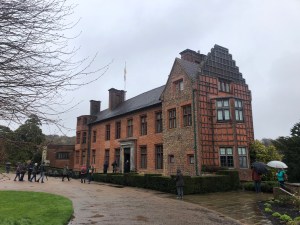
My first Churchill tribute trip was via the train from London to Oxted, where my childhood friend Georgie kindly met me and we drove to Chartwell.  Chartwell was purchased by Churchill and his wife Clementine in 1922, and was much loved by the family.  Churchill himself said that “a day away from Chartwell is a day wasted”.  The home was donated to the National Trust following Churchill’s death. 

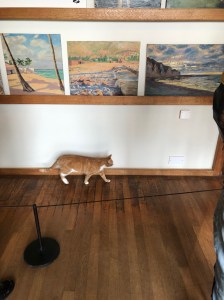
When the family donated the home, they stipulated that there must always be “a marmalade cat named Jock, with a white bib and four white socks, in comfortable residence at Chartwell”.  I felt lucky to see Jock VII on the day we visited, clearly living very comfortably indeed!

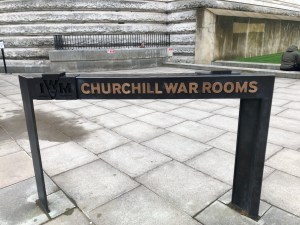
My next Churchill tribute was visiting the Churchill War Rooms with my friend Kat.  This is a fascinating museum.  The War Rooms were the secret underground headquarters for the British War Cabinet and the core government activities throughout World War II.  The rooms were locked on 16 August 1945 and left undisturbed.  Knowledge of and access to the site remained highly restricted until the late 1970s, and the rooms were not opened to the public until 1984.  The war was truly won from these rooms – this is definitely worth a visit if you are in London.

Overall, I was struck by how prolific Churchill’s life was, in so many ways.  He built most of the extremely long and tall brick walls at Chartwell.  He painted more than 500 finished canvasses, many of which were painted at overseas locations in a time when travel was not as fast or easy as it is now.  He wrote 43 book-length works in 72 volumes.  His passion, commitment and output alone are inspiring.

I don’t agree with all of Churchill’s philosophies (his racist views are particularly repugnant), but I think he was very human  – complex, capable of showing great humanity and humility, and also a keen learner.  I think a modern Churchill would hold remarkably different views about many things, including race.

For example, following the Dardanelles failure, Churchill resigned his post as First Lord of the Admiralty, then went to fight on the Western Front.  This shows enormous humility, accountability to his fellow man and a desire to learn more and become better through experience.

Churchill also believed in us making the world better for those who come after us.  He knew that the world doesn’t stay the same; it changes because we as people change – and education, travel and experience are key inspirations for that change.  I remain so grateful for this opportunity to learn, travel and experience different cultures and thinking, and hopeful this will combine to help me create change.


A special start

It was my first official meeting day today, and what a special way to start the formal part of my Fellowship.

A while ago, I became aware of the lovely work Hayley Ellenton had undertaken as a nurse caring for families experiencing early pregnancy loss in Hull, UK.   Hayley created Forget-Me-Not memory boxes for families to pay tribute to their baby lost during early pregnancy.

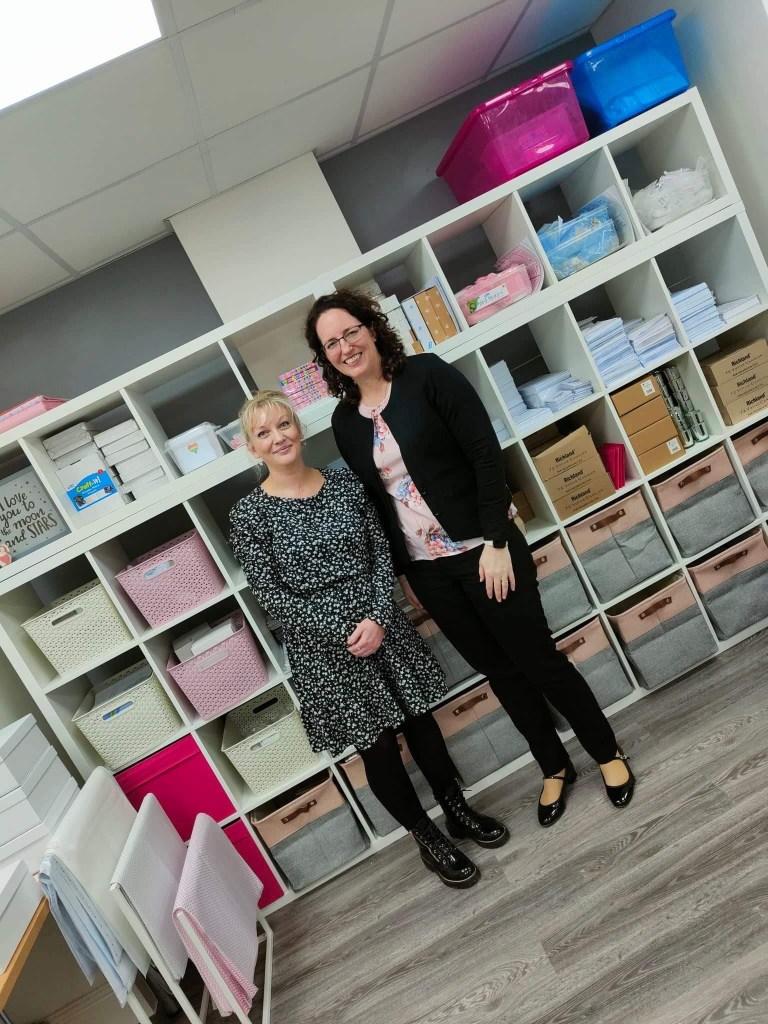
When I knew I was travelling to the UK, I reached out to Hayley, who organised for us both to meet along with Katy Cowell from Abbie’s Fund.  Abbie’s Fund has had the ongoing responsibility for making and distributing the Forget-Me-Not boxes for the past few years.

This morning, I was very honoured to be the first guest welcomed into the new premises for Abbie’s Fund, in the (gorgeous) village of Beverley near Hull. 

with Katy Cowell, Abbie’s Fund
with Hayley Ellenton

I had a lovely morning getting to know Hayley and Katy, while also feeling like I had known them both for ages.  Anyone wandering into the office would have thought we were three old friends having a cup of coffee together. 

I find that people generally are generous and willing to help one another.  In my experience, this is even more so when people share the pregnancy bereavement space.  It means you already speak some of the same language, even though you might be from different countries and have never met before.  While all our experiences are individual, you can appreciate the depths a fellow bereaved parent has been to.

It was very powerful and inspirational today to be in the company of two women who have done so much to significantly improve the experience of pregnancy loss for families.

Katy kindly showed me the beautiful memory boxes produced by Abbie’s Fund.  They are, quite simply, exquisite.  So much obvious care, thought and love has gone into preparing these incredibly special boxes.  The Fund provides boxes for many circumstances, including early pregnancy loss, stillbirth, the loss of a baby due to SIDS/illness, and for children who have lost a sibling or parent. 

I am honoured to be carrying two of these precious boxes home to Australia.

In the space of two short hours, I learnt so many new concepts that will help to improve care for bereaved families.  I am so grateful to Hayley and Katy for their generosity in sharing their time, thoughts and ideas with me regarding support for families through pregnancy loss.  It’s only day one and I’m already full of new ideas (and keen to start implementing them!)…what a gift this Fellowship is already proving to be.

For me, I knew I was in the right place as soon as I arrived.  The new couch at Abbie’s Fund has dragonflies on the cushions.  Dragonflies have always been my special symbol for Charlie; I feel like my little boy was letting me know I am on the right path.

Leave a comment

Bittersweet

Embarking on my Churchill Fellowship this week has provided an opportunity for reflection.  I am truly excited to be starting this trip, but the experience is very bittersweet.  While I’m off on an adventure to explore in-hospital volunteer programs supporting families experiencing pregnancy loss, I’m also leaving my husband Daniel behind for 9 weeks.

We have been together for 30 years this year and have only ever been apart for a few weeks at the most.  Daniel is not just my husband; he’s my best friend, my confidant, my number one supporter. 

I more or less kept it together in the week leading up to my departure, but at Canberra Airport, the prospect of nine weeks apart became pretty overwhelming.

Thanks to the kindness of strangers, I had it all back under control again once we landed in Melbourne.  But on the trip from Melbourne to Manchester, I made the mistake of watching the movie A Man Named Otto.  It’s an excellent movie and I highly recommend watching it, but only if you’re emotionally ready for it (and perhaps not when you’ve just left the love of your life behind for a few months).  My apologies to my fellow passengers for the lack of tissues in the bathroom. 

So yes, this amazing trip is bittersweet.

“Bittersweet” has been the resounding theme of our pregnancy losses and my subsequent advocacy work.

There is an exquisite beauty in pregnancy and bearing children, even when those children are lost. 

It is a pleasure to remember our babies, even though it also holds the greatest, infinite sadness.

My achievements in the pregnancy loss space bring a quiet pride and happiness, but this is always in the context of remembering all the babies who have been lost, and the brave families who have shared their stories with me.

In working to heal from pregnancy loss and helping others through their own experiences, I have realised how important it is to feel all the feelings; to sit with them and let them exist in all their joy or sadness.  I have also realised that no experience is ever full of just one emotion.  Happy experiences can be tinged with sadness, while life’s worst experiences can also contain joy and even humour.

It seems right that this Fellowship provokes those same bittersweet, conflicting feelings, even at the outset.  I have no doubt this will continue as I meet professionals, volunteers, parents and families over the next nine weeks.  I’m ready and determined to embrace all the feelings, and to learn all I can.

Leave a comment